Growth and Connection

Showing posts with label food industry. Show all posts

Monday, November 2, 2009

The Cattle Crisis - Brazil


The cattle industry cannot keep up with the rising, global demand for quality produce. It is a matter of production inefficiency: the means cannot keep pace and profit at the same time. However, Brazil, among other major suppliers, cannot afford falling behind said pace, hence government subsidies. This becomes a problem for the subsistent locals when they can no longer compete with subsidized imports, an issue of free trade arises.


The practice is subsidized because it is inefficient, with the expense of capital secondary to the expense of the environment:


Cattle ranching is the primary driver of deforestation in Earth's largest rainforest, the Brazilian Amazon.1

The research shows that more than 38,600 square miles has been cleared for pasture since 1996, bringing the total area occupied by cattle ranches in the Brazilian Amazon to 214,000 square miles, an area larger than France.2


Environmental issues of deforestation aside, it is a matter of inefficient and unsustainable land usage:


…the soil that is cleared in slash and burn is left infertile, the nutrients in the soil are quickly absorbed by surrounding organisms. The farmers must move on sometimes to other areas and repeat this process and worthy land and trees become scarce. For farmers in places like Brazil, slash and burn methods are the only way to effectively clear land of parasites and unwanted organisms; chemical means contaminate water and soil and farmers continue to turn to slashing and burning.3


Reasons why the cattle industry thrives in Brazil:


INTEREST RATES—Rainforest lands are often used for land speculation purposes. When real pasture land prices exceed real forest land prices, land clearing is a good hedge against inflation. At times of high inflation, the appreciation of cattle prices and the stream of services (milk) they provide may outpace the interest rate earned on money left in the bank.


LAND TENURE LAWS—In Brazil, colonists and developers can gain title to Amazon lands by simply clearing forest and placing a few head of cattle on the land. As an additional benefit, cattle are a low-risk investment relative to cash crops which are subject to wild price swings and pest infestations. Essentially cattle are a vehicle for land ownership in the Amazon.4


Brazil has become the world’s largest exporter of beef, and a major supplier of leather. The demand is global: beef to fast food chains expanding internationally and leather to global brands like Adidas, Nike, Reebok, and Timberland.


Greenpeace Forest Campaigner Lindsey Allen: “To be true climate leaders, Nike, Adidas, Timberland and other brands must help protect the Amazon and our climate by refusing to buy leather from deforestation. In the fight against climate change, every step counts.”5


The problem is that Brazil’s economy depends heavily on its Amazon exploits:


Brazilian deforestation is strongly correlated to the economic health of the country: the decline in deforestation from 1988-1991 nicely matched the economic slowdown during the same period, while the rocketing rate of deforestation from 1993-1998 paralleled Brazil's period of rapid economic growth.6


Therefore, any solution must take this economy into consideration. According to Roberto Smeraldi, (Amigos da Terra, Activist group) one such solution “involves improving the productivity of cattle ranching, thereby allowing forest to recover without sacrificing jobs or income.”7 Increasing productivity would allow for a reduction in pasture size.


There are some approaches worth considering, though none solely practicable as of yet.


One possibility is to condition cattle into grazing sustainable alternatives: here is research into the conditioning process and a proposition of snakeweed as the substitute, http://jas.fass.org/cgi/content/full/82/10/3100.


Also potentially an option is turning to genetics technology, which has already involved itself in the cattle industry: improving the Brazilian breed for ‘mass production’ through in vitro fertilization and cloning. Changing grazing habits and needs by breed and genetic modification is the concept, perhaps using miniature breeds and their high density capacity for some direction. Of course, miniature-breed ranching using rotational grazing systems already exist sustainably, but only as an option for a subsistence setting; dispersing the industry is a global solution, but not viable from Brazil’s economic perspective.


The bottom line is that as industry develops, overconcentration becomes not just an environmental issue, but an urban issue in poor land usage. The optimal solution would maximize production efficiency and minimize resource waste.


-Nathan Tung

Sources:

· 1 Butler, Rhett. "Beef drives 80% of Amazon deforestation,” mongabay.com (2009), http://news.mongabay.com/2009/0129-brazil.html. (accessed November 1, 2009).

· 2,4,6 Butler, Rhett. "Amazon Destruction: Why is the rainforest being destroyed in Brazil?;” The Amazon (2009), http://rainforests.mongabay.com/amazon/amazon_destruction.html. (accessed November 1, 2009).

· 3 Stock, Jocelyn. "The Choice: Doomsday or Arbor Day," http://www.umich.edu/~gs265/society/deforestation.htm (accessed November 1, 2009).

· 5 Beltra, Daniel. "Top name brands implicated in Amazon destruction,” Greenpeace (2009), http://www.greenpeace.org/usa/news/slaughtering-the-amazon. (accessed November 1, 2009).

· 7 Butler, Rhett. "Activists target Brazil's largest driver of deforestation: cattle ranching,” mongabay.com (2009), http://news.mongabay.com/2009/0908-smeraldi.html. (accessed November 1, 2009).

· Consulate General of Brazil. “Technology and Tailored Cows in Brazil” http://www.brazilianconsulate.org.hk/docs/7-Technology%20and%20Tailored%20Cows%20in%20Brazil.pdf (accessed November 1, 2009).

· Greenpeace Brazil. “Amazon Cattle Footprint,” Greenpeace (2009), http://www.greenpeace.org/raw/content/international/press/reports/amazon-cattle-footprint-mato.pdf (accessed November 1, 2009).

· Journal of Animal Breeding & Genetics; Apr2006, Vol. 123 Issue 2, p97-104, 8p, 9 charts

Image Sources:

· Butler, Rhett. "Amazon Destruction: Why is the rainforest being destroyed in Brazil?;” The Amazon (2009), http://rainforests.mongabay.com/amazon/amazon_destruction.html. (accessed November 1, 2009).

· Greenpeace Brazil. “Amazon Cattle Footprint,” Greenpeace (2009), http://www.greenpeace.org/raw/content/international/press/reports/amazon-cattle-footprint-mato.pdf (accessed November 1, 2009).

Sunday, November 1, 2009

Energy Inefficiency in the Food Industry


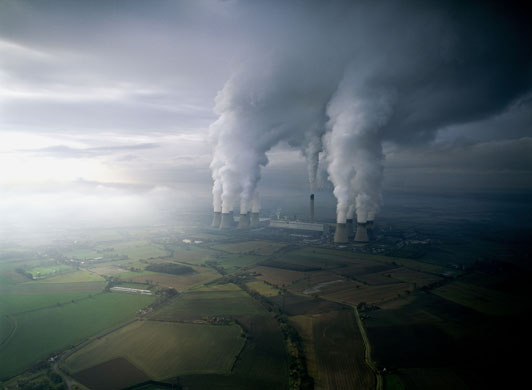
The discovery of fossil fuels as an energy source has greatly increased production processes. It has proven to be so effective that 85% of the energy in the U.S. is produced by burning fossil fuels. This increase in production also includes the production of food. However, the emissions given off by the combustion of fossil fuels to create this energy has also harmed the food industry, and will continue to do so unless we begin using alternative production methods. One of the effects of these emissions that is causing the most concern is global warming.


http://www.newscientist.com/data/images/ns/cms/dn11639/dn11639-2_808.jpg


The earth’s surface temperatures are currently expected to increase by 0.2 degrees celsius every ten years. This increase would create better growing conditions for food in northern regions, but at the same time could also make regions close to the equator too hot to grow certain types of food. The change in temperature would also provide a larger habitable area for insects that destroy crops. Another repercussion is an increased evaporation rate, thereby reducing the supply of water available for food growth. In addition, sea levels would rise as global warming is causing the ice caps to melt.


http://www-tc.pbs.org/wgbh/nova/megavolcano/images/shin-nasa-gfsc-meltwater-l.jpg


Low-altitude agricultural regions would eventually become completely submerged. This loss of growing area would cause the demand and the price of food to increase dramatically. Fossil fuel combustion is also resulting in an increase in ozone levels at the earth’s surface. Although it is a necessary component of the atmosphere, it is hazardous to both animals and vegetation at ground level. Ozone is formed when nitrogen oxides and volatile organic compounds (which are both emitted during fossil fuel combustion) react with each other. The resultant ozone is being absorbed by crops, and destroying them - in 1990, over $215 million in crops were destroyed in the U.K. In these ways, our use of fossil fuels and energy consumption is destroying the growth, production, and economy of a vital resource. For more information, check out these sources on energy consumption and how it affects the food industry: Agriculture, Food Production Daily, and Monitoring Energy Efficiency in the Food Industry.


Although greenhouse gas emissions resulting from the burning of fossil fuels is negatively affecting food production, the energy consumption of the food industry itself is also contributing to greenhouse gas emissions. The food industry uses about 10% of the the total energy consumed in the U.S., and the growth and production processes are extremely energy inefficient - it takes three calories of energy just to produce one calorie of food. Much of the energy used in food production isn’t actually put towards growing food, either - 40% is used to produce fertilizers, 23% is used to process and package the food, and another 32% comes from its refrigeration and cooking.


Diesel fuel is also consumed by farm machinery used for planting, tilling, and harvesting crops, as well as vehicles that transport food to finish being processed or to be sold. The large amount of energy being used so inefficiently is impacting the economy of the food industry. Right now, it is resulting in reduced incomes and losses of jobs as food production companies go out of business. This has a large impact on the economy, as 35% of the U.S. work force works in the food industry. Eventually, as the demand for food becomes greater, food prices will increase and agricultural exports will drop. In order to sustain the food industry and its economy, the industry must develop less expensive, more energy-efficient methods of food production. Check out these websites on energy usage in food production: Food Production Daily, and Sustainable Table.


There are many ways farmers can decrease both their energy consumption and expenses in food growth, production, and transportation, by practicing sustainable farming. One of the simplest ways to do this is to sell their products locally.


http://www.filaskyfarm.com/images/farm_stand.jpg


This simply means that less fuel is used to transport the food, therefore the farmer spends less money and uses less energy. Eliminating the process of tilling the soil can also save energy and money, as the farm equipment that would normally till the soil requires about 3.9 gallons of diesel fuel per acre of land. On an average farm of about 740 acres, the farmer would save 2886 galleons of fuel and almost $7 720. Refraining from tilling the soil also counteracts some of the effects of fossil fuel combustion. When plants absorb carbon, they draw it down into the soil and out of the air. By not tilling the soil, the carbon is able to stay in the ground. Farmers can also cut down on the large amount of energy used in the production of fertilizer by using manure, a natural fertilizer. If animals are allowed to graze in the fields, they feed themselves as well as spread manure. This greatly reduces the cost of fertilizer and feed for the animals, as well as the fuel needed to transport them to the farm. These simple practices allow farmers to save energy and reduce the impact of global warming on food production, as well as save money to sustain the economy of the food industry. Check out this information on sustainable farming: Sustainable Table.

- Stephanie Fleming


Works Cited

Buchdahl, Joe and Hare, Sue. "Agriculture." Encyclopedia of the Atmospheric Environment. 2000. http://www.ace.mmu.ac.uk/eae/Global_Warming/Older/Agriculture.html (accessd October 25, 2009).


Decision News Media. "Energy efficient food safety." Food Production Daily. April 27, 2004. http://www.foodproductiondaily.com/Processing/Energy-efficient-food-safety (accessd October 25, 2009).


Fletcher, Anthony. "Food production hit by increasing ozone levels." Food Production Daily. October 8, 2004. http://www.foodproductiondaily.com/Supply-Chain/Food-production-hit-by-increasing-ozone-levels (accessed October 25, 2009).


Ramirez, C. A. "Monitoring Energy Efficiency in the Food Sector." Utrect University. September 22, 2005. http://www.chem.uu.nl/nws/www/publica/Publicaties2005/E2005-66.pdf (accessed November 1, 2009).
Sanders, Rich. "Fossil fuel and energy use." Sustainable Table. 2003. http://www.sustainabletable.org/issues/energy/ (accessed October 25, 2009).